填空题
公共英语四级
2018-03-04
听录音,回答题
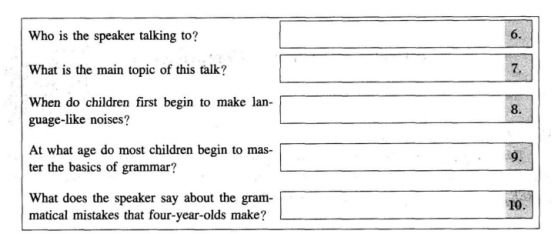
第6题答案
参考答案
暂无
答案解析
听力材料:
Now, in the last few minutes of class, I' d like to address a slightly dif- ferent issue: the question of how children learn to talk. Learning to speak their own language is one of children' s greatest accomplishments, yet it is a somewhat mysterious process. Children first begin to make language-like noises when they are between two and four months old. These noises gener-ally begin with the letters "g" and "k" and because these sounds--" goo" and "koo"--are the easiest sounds for infant mouths to make. Between four months and eight months, infants begin to babble meaningless syllables.
Most common are those beginning with "p", "b", "d", "m", or "n" sounds, followed by a vowel sound. Parents sometimes misinterpret these as actual words, such as mama or dada. Between six months and a year, babies say their first true words. Vocabulary grows slowly at first, usually only a few words a month, but once a child has learned about fifty words--general-ly around 18 months--the pace picks up rapidly. At first, children say single words; then they begin forming two-word combinations: "all gone" "more milksee doggie. " Children' s two word combinations are so similar to the world over that they read like translations of one another. Between the age of two and three, children can form complete sentences and have mastered the basis of grammar. Can you believe it? A two-and-a-half-year-old toddler is a grammatical genius and all without studying a single rule! Typically, four- year-old know some 15,000 words and can form very sophisticated sen-tences. Even their mistakes are very logical: "I saw two mans" or "We went to gramma' s house. " So, how does this all happen? Welt, there are several conflicting theories about language acquisition, but unfortunately,there just isn' t time to discuss them today, so we' ll take them up in ss Wednesday' s class. In the meantime, please read Chapter Eight in your textbook. See you Wednesday.
答案:
His students.
Now, in the last few minutes of class, I' d like to address a slightly dif- ferent issue: the question of how children learn to talk. Learning to speak their own language is one of children' s greatest accomplishments, yet it is a somewhat mysterious process. Children first begin to make language-like noises when they are between two and four months old. These noises gener-ally begin with the letters "g" and "k" and because these sounds--" goo" and "koo"--are the easiest sounds for infant mouths to make. Between four months and eight months, infants begin to babble meaningless syllables.
Most common are those beginning with "p", "b", "d", "m", or "n" sounds, followed by a vowel sound. Parents sometimes misinterpret these as actual words, such as mama or dada. Between six months and a year, babies say their first true words. Vocabulary grows slowly at first, usually only a few words a month, but once a child has learned about fifty words--general-ly around 18 months--the pace picks up rapidly. At first, children say single words; then they begin forming two-word combinations: "all gone" "more milksee doggie. " Children' s two word combinations are so similar to the world over that they read like translations of one another. Between the age of two and three, children can form complete sentences and have mastered the basis of grammar. Can you believe it? A two-and-a-half-year-old toddler is a grammatical genius and all without studying a single rule! Typically, four- year-old know some 15,000 words and can form very sophisticated sen-tences. Even their mistakes are very logical: "I saw two mans" or "We went to gramma' s house. " So, how does this all happen? Welt, there are several conflicting theories about language acquisition, but unfortunately,there just isn' t time to discuss them today, so we' ll take them up in ss Wednesday' s class. In the meantime, please read Chapter Eight in your textbook. See you Wednesday.
答案:
His students.