全部题库 / 高中英语 / 试题详情
简答题 高中英语
2023-01-31

下面是某节阅读课的板书设计。
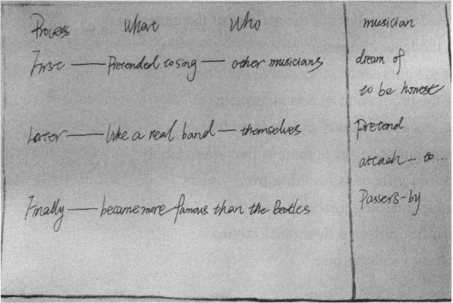
 

根据所给板书从下列三个方面作答。
(1)简要说明该板书的类型。(3分)
(2)分析该板书的优点和缺点。(15分)
(3)设计板书时的注意事项有哪些?(12分)

参考答案

暂无

答案解析

 (1)类型:该板书是线索式板书,即根据教学内容,用表示时间、地点、人物、事件、原因、结果等的关键词为主线进行的板书设计。
(2)优点:
①该板书在左侧将课文重点和关键信息呈现出来,如事情发展的过程、行为及行为主体,使学生一目了然,不仅突出了教学重点,而且有助于学生明确课文中故事情节的发展脉络,把握课文的主要内容。
②该板书在右侧单独呈现了本节课的重点单词及短语,便于教师讲解和学生理解。
缺点:
①该板书缺少标题,不利于学生明确本节课所学主题。
②该板书呈现的单词及短语脱离语境,也没有结合课文结构和脉络,不利于学生记忆。
③该板书字迹潦草,不够美观,不仅影响学生的学习积极性,还不利于学生养成良好的书写习惯。
(3)注意事项:
①板书的设计要与课堂教学的内容及学生的学习水平密切相关。教师应根据课堂教学内容,选择合适的板书类型呈现教学内容,并针对学生的实际水平,突出教学重点和难点。
②板书设计要具有概括性、提示性,要结构合理、条理清晰。板书要呈现课堂教学的主要内容,所以教师要抓住重点、合理布局,使板书内容简洁明了、主线清晰。
③教师要合理把握板书的时机,提前安排好何时板书。另外,教师板书的时间不宜过长,否则长时间背对学生,不仅影响师生视线交流,还会影响教学进度,使学生松懈并产生厌烦情绪。
④教师板书的字体应工整、规范、美观,这样可以潜移默化地培养学生的审美情趣及良好的书写习惯。

你可能感兴趣的试题

1 设计任务:根据下面的学生信息和语言素材,设计20分钟的阅读教学方案。教案没有固定格式,但须包含下列要点:
·teaching objectives
·teaching contents
·key and difficult points
·major steps and time allocation
·activities and justifications
教学时间:20分钟
学生概况:某城镇普通中学高中一年级学生,班级人数40人。多数学生已经达到《义务教育英语课程标准(201 1年版)》五级水平。学生课堂参与积极性一般。
语言素材:
If you say the word "communication" , most people think of words and sentences. Althoughthese are very important, we communicate with more than just spoken and written words. Indeed,body positions are part of what we call "body language" . We see examples of unconscious bodylanguage very often, yet there is also "learned" body language, which varies from culture to culture.
We use "learned" body language when we are introduced to strangers. Like other animals, weare on guard until we know it is safe to relax. So every culture has developed a formal way to greetstrangers, to show them we are not aggressive. Traditionally, Europeans and Americans shake hands.They do this with the right hand--the strongest hand for most people. If our right hand is busygreeting someone, it cannot be holding a weapon. So the gesture is saying, "I trust you. Look, I'mnot carrying a threatening weapon." If you shake hands with someone, you show you trust them. Weshake hands when we make a deal. It means, "We agree and we trust each other."
Greetings in Asian countries do not involve touching the other person, but they always involvethe hands. Traditionally in China, when we greet someone, we put the right hand over the left andbow slightly. Muslims give a "salaam" , where they touch their heart, mouth and forehead. Hindusjoin their hands and bow their heads in respect. In all of these examples, the hands are busy with thegreeting and cannot hold a weapon.
Even today, when some people have very informal styles of greeting, they still use their handsas a gesture of trust. American youths often greet each other with the expression, "Give me five!"One person then holds up his hand, palm outwards and five fingers spread. The other person raiseshis hand and slaps the other's open hand above the head in a "high five" . Nowadays, it is quite acommon greeting.
Body language is fascinating for anyone to study. People give away much more by theirgestures than by their words. Look at your friends and family and see if you are a mind reader!
注:语言素材选自外研版必修4 Module 3 Body Language and Non —verbal Communication第22页。
A.Susan of me
B.Susan took
C.Susan took of me
D.Susan took a picture
A.That male lions help
B.Male lions which help
C.Although male lions help
D.It is male lions that help