全部题库 / 英语 / 试题详情
单选题 英语
2016-06-14

阅读文章,回答题
(B)
Is there link between humans and climate change or not? This question was first studied in the early 1900s. Since then, many scientists have thought that our actions do make a difference. In 1997, the Kyoto Protocol explained our role in the Earth’s changing atmosphere and set international limits for gas emissions(排放) from 2008 to 2012. Some countries have decided to continue these reductions until 2020. More recently, the Paris Agreement, stuck by nearly 200 countries, also aims to limit global warming. But just now how much warmer it will get depends on how deeply countries cut carbon emissions.
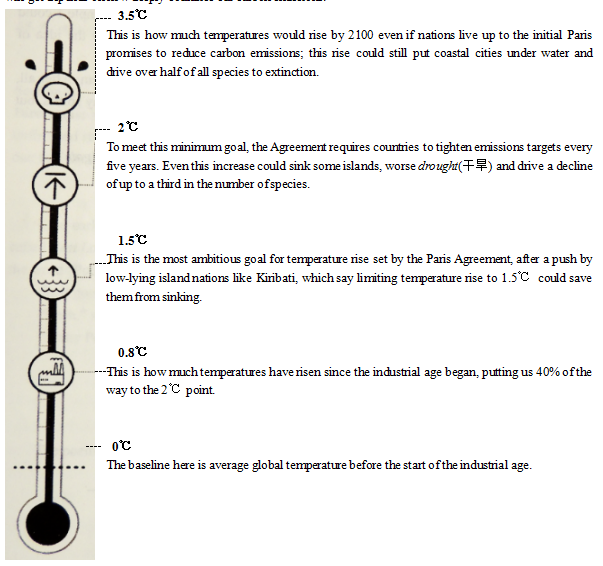
It can be concluded from paragraph 1 that _______.

A.the problem of global warming will have been quite solved by 2020
B.gas emissions have been effectively reduced in developed countries
C.the Paris Agreements is more influential than the Kyoto Protocol
D.humans have made continuous efforts to slow down global warming

参考答案

D

答案解析

D

你可能感兴趣的试题

A.The human population would increase by one third.
B.Little over 50% of all species would still exist.
C.Nations would not need to tighten their emissions targets.
D.The Agreement’s minimum goal would not be reached.
3
阅读文章,回答题
(C)
Enough “meaningless drivel”. That’s the message from a group of members of the UK government who have been examining how social media firms like LinkedIn gather and use social media data.
The House of Commons Science and Technology Committee’s report, released last week, has blamed firms for making people sign up to long incomprehensible legal contracts and calls for an international standard or kitemark (认证标记) to identify sites that have clear terms and conditions.
“The term and conditions statement that we all carelessly agree to is meaningless drivel to anyone,” says Andrew Miller, the chair of the committee. Instead, he says, firms should provide a plain-English version of their terms. The simplified version would be checked by a third party and awarded a kitemark if it is an accurate reflection of the original.
It is not yet clear who would administer the scheme, but the UK government is looking at introducing it on a voluntary basis. “we need to think through how we make that work in practice,” says Miller.
Would we pay any more attention to a kitemark? “I think if you went and did the survey, people would like to think they would,” says Nigel Shadbolt at the University of Southampton, UK, who studies open data. “We do know people worry a lot about the inappropriate use of their information.” But what would happen in practice is another matter, he says.
Other organisations such as banks ask customers to sign long contracts they may not read or understand, but Miller believes social media requires special attention because it is so new. “We still don’t know how significant the long-term impact is going to be of unwise things that kids put on social media that come back and bite them in 20 years’ time,” he says.
Shadbolt, who gave evidence to the committee, says the problem is that we don’t know how companies will use our data because their business models and uses of data are still evolving. Large collections of personal information have become valuable only recently, he says.
The shock and anger when a social media firm does something with data that people don’t expect, even if users have apparently permission, show that the current situation isn’t working. If properly administered, a kitemark on terms and conditions could help people know what exactly they are signing up to. Although they would still have to actually read them.
What does the phrase “ meaningless drivel” in paragraphs 1 and 3 refer to?
A.Legal contracts that social media firms make people sign up to.
B.Warnings from the UK government against unsafe websites.
C.Guidelines on how to use social media websites properly.
D.Insignificant data collected by social media firms.